the demonisation of the working class
the demonisation of the working class
What is the true definition of class? No set wage threshold exists to determine what class someone belongs to; but rather a variety of social, political and economic factors. Class in the United Kingdom (the area of focus for this research) has changed significantly over the last 40 years, with politicians claiming the UK is a workless society; the media representing the working class as benefit hoarders; and false representation in TV shows such as Jeremy Kyle. The word “Chav”, a derogatory and classist descriptor of working class people, is frequently thrown around. So, when did ridiculing the working class become socially acceptable? How many times have you been around your left-of-centre friends who would never dream of saying anything racist, sexist, or homophobic, but will label the working class as benefit-scrounging chavs? This zine attempts to explore the normalisation of the hatred of the working class within politics; media; and entertainment; as well as the appropriation of the working-class aesthetic in middle class environments.
How Margaret Thatcher destroyed the working class
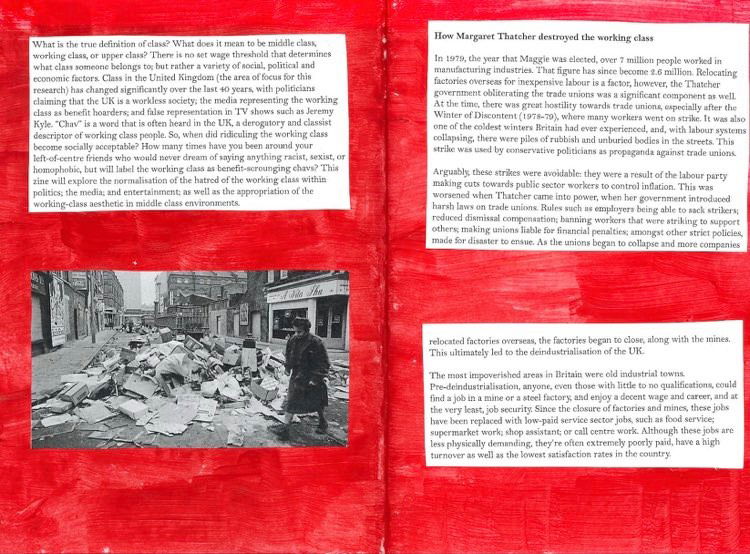
In 1979, the year that Maggie was elected, over 7 million people worked in manufacturing industries. This figure has since dwindled to 2.6 million. Relocating factories overseas for inexpensive labour was a factor, however, the Thatcher government obliterating the trade unions caused significant impact. During that period, there was great hostility towards trade unions, especially after the Winter of Discontent (1978-79), where many workers went on strike. It was also one of the coldest winters Britain had ever experienced, and, with labour systems collapsing, there were piles of rubbish and unburied bodies in the streets. Conservative politicians used this strike as propaganda against trade unions.
Arguably, these strikes were avoidable - they were a result of the labour party making cuts towards public sector workers to control inflation. This was worsened when Thatcher came into power, when her government introduced harsh laws on trade unions. Rules such as employers being able to sack strikers; reduced dismissal compensation; banning workers that were striking to support others; making unions liable for financial penalties; amongst other strict policies, made for disaster to ensue. As the unions began to collapse and more companies relocated factories overseas, the factories began to close, along with the mines. This ultimately led to the deindustrialisation of the UK.
The most impoverished areas in Britain were old industrial towns. Pre-deindustrialisation, anyone, even those with little to no qualifications, could find a job in a mine or a steel factory, and enjoy a decent wage and career, and at the very least, job security. Since the closure of factories and mines, these jobs have been replaced with low-paid service sector jobs, such as food service; supermarket work; shop assistance; or call centre work. Although these jobs are less physically demanding, they’re often extremely poorly paid, have a high turnover as well as the lowest satisfaction rates in the country.
Deindustrialisation isn’t the only factor that led to the destruction of the working class - the “right to buy” scheme for council house owners was also a culprit. The initial idea of the council estate was to provide people with affordable and safe housing with some degree of conviviality. Pre-Thatcher, 2 in 5 people lived in a council house. Post-Thatcher, this became 1 in 10. The “right to buy scheme” is a policy that gives secure tenants the legal right to buy the council house in which they reside. The longer the tenant lives in the house, the more the house is discounted. The introduction of this scheme was a means for more people to be involved in the property market, for the goal of a middle-class society. But what about those who can’t afford to buy their council house? The idea of the right to buy scheme is positive in theory; but not enough council houses were being built to match up with how many were being bought. The remaining council houses were being given to the top priority people who needed them, i.e. the most vulnerable people in society and the most impoverished. Before Thatcher came into power, around 75,000 council houses were built per year. In 2010, 320 were built. The government now spends significantly less on social housing, but much more is being spent on housing benefits, which are being paid to private landlords. So, council houses were being given to the people who were the most in need: single mothers; the recently institutionalised; or ex-prisoners. By this point, 2/3 of the people who lived in public housing were part of the poorest 2/5 of the population.
Old Maggie was a hardcore individualist. She didn’t believe in people bettering their lives through collective action within the community, but rather by individual self-improvement. She seemed to toy with the notion that poverty didn’t “exist”, because it is up to the individual to escape poverty, (despite poverty often being inflicted by government policy). Thatcher would often avoid discussing class or even publicly acknowledging its existence, because if the public concludes that one group in society hoards wealth and power, changes will be demanded. Thatcher destroying unions was her way of destroying the working class as a collective, leaving behind working class individuals who were turning against each other, trying to scramble into the middle class.
Areas affected by deindustrialisation are the most impoverished areas, and have the highest unemployment rates. The government, along with mainstream media, has managed to shift the blame for this onto the working class, claiming the individuals don’t work hard enough, or aren’t skilled enough, or are lazy. Under the labour government in 1979, unemployment was just below 1 million. It’s estimated that the Thatcher government put around 4 million people out of work, due to clamping down on unions and the subsequent shutdown of industries. By 1983, 1/3 of manufacturing had disappeared from the UK.
To summarise, industries were no longer thriving in Britain, due to government policies and the destruction of unions. In 1979, it’s estimated that around 5 million people in the UK were living in poverty. In 1992, it was 14 million. Public spending on benefits actually spiked when Margaret Thatcher was prime minister, mostly due to the loss of secure jobs; the crime rates doubled from 1979 to 1990, so in this way the connection between crime and unemployment was clear - the communities most affected by deindustrialisation had the highest crime rates. Thatcher blamed this crime spike on individual acts, committed by individual; you guessed it - working-class people, rather than this being a symptom of deindustrialisation and poverty.
The demonisation of working class in politics
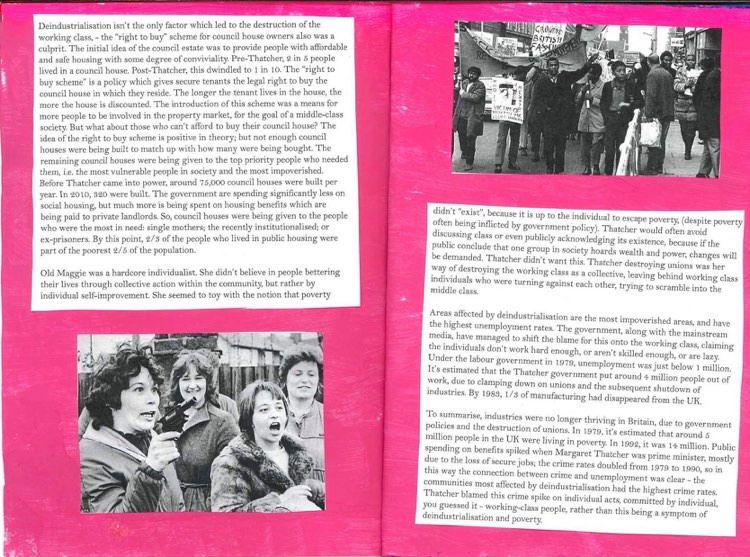
Demonising the working class is a tactic used by politicians to justify an unequal society. The idea that the working class is there because they deserve to be, and if they had more talent, skill and determination, then they could become middle class, is a ridiculous idea, shrouded in privilege. Since Thatcherism and deindustrialisation, the working class has been under attack. They were constantly belittled and mocked, leading to today’s attitude of the desire to escape the working class, rather than improving the working class itself. According to conservative politics, social problems such as poverty and unemployment are no longer issues caused by the government or capitalism, but are consequences of personal behaviour. Essentially, to be working class is a choice. Again, there is a strong focus on individualism within politics. Tabloid representation of the working class is shocking, but politicians will piggyback on extreme cases like Karen Matthews or Mick Philpot as tools to justify attacking the working class through cuts to the welfare system. If the voting British public believe that the working class is capable of heinous crimes, they’ll be likely to support policies that attack them.
Additionally, there is a significant lack of working class representation within parliament - 29% of all MPs are privately educated, 45% of Conservative and 15% of Labour, and 2/3 of Boris Johnson’s cabinet were privately educated. In 1979, 15% of MPs started as manual workers and this dwindled to 3% in 2015. Just because someone is from a privileged background, doesn’t mean they can’t be sympathetic to those who are from a different walk of life to them, but it may be harder for them to understand the true realities of being working class. In 2010, in UK politics and subsequently the media, there was a focus on benefit fraud - people wrongly claiming benefits, or women giving birth to multiple children to receive more benefits. Benefit fraud and error cost the taxpayer £2.6 billion in 2015, approximately 2% of the welfare budget. Bear in mind that this figure also includes errors from taxpayers themselves such as overpayment. Between 2011 and 2012, only 0.8% of benefits were claimed fraudulently. Additionally, over £10 billion of benefits went unclaimed in 2016, and most people in poverty are employed. In a Joseph Rowntree Foundation report (2020), 56% of people living in poverty in 2018 were in a household where at least one person had a job, compared with 39% 20 years ago. But of course, the politicians and media conveniently redact this information from campaigns and news stories.
Let’s not forget tax evasion - a crime mostly committed by middle and upper classes. This cost the taxpayer £30 billion in 2015. Conservative politicians and right wing tabloids don’t mention that tax evasion is a middle-class problem, or that everyone in the middle class evades tax in the same way that they stereotype the working class as everyone claiming benefits fraudulently. There are less jobs available in working class areas, because the industries that kept these areas alive are now gone. It’s impossible to claim that everyone on unemployment benefits is work shy and lazy, when in 2017 there were 1.5 million unemployed people but only 700,000 job vacancies. Of course, blaming the working class, rather than government policies, makes it far easier to justify an unequal society.
At this point one might wonder, how does the conservative party win elections? It’s one of the most successful political parties in Europe. Their success could be explained by the party giving just enough, to just enough people, thus appealing to people from all classes. In the late 19th century, conservative prime minster Benjamin Disraeli reduced the maximum working day to 10 hours and banned children from working full-time. Many believe that these were tactical actions to gain loyalty from the working class, because ultimately, the conservative party strives to protect the wealthiest in society. They have a populist approach, trying to appeal to as many people as they can, especially as many “ordinary” people as possible. For example, for people who fear the rising crime rates in their area, the conservative, tough-on-crime approach will appeal. If one worries that immigrants are taking jobs, conservatives promise more restrictive immigration laws, which will appeal. Single mothers have also been targeted by politicians - as benefit scroungers who have children for more money and a bigger council house. It’s deplorable to attack working class, single mothers who are simply trying to raise their children.
This is not a one-time trend. Politicians and media will pick out groups within the working class, to turn them against each other, by appealing to the slightly more well off working class, almost as if to say, “there’s room in the middle class for you too”. Politicians will often say that poverty is caused by problematic family dynamics such as a lack of discipline, substance abuse and family breakups. Social problems in working class communities are also often exaggerated by politicians and passed off as representative. A prime example of this is the case of Alfie Patten; a 13-year-old boy who was Britain’s youngest dad. It was plastered all over the news and politicians discussed it excessively. It turned out that Alfie was not the father of this child. This news was not as well circulated as the initial story.
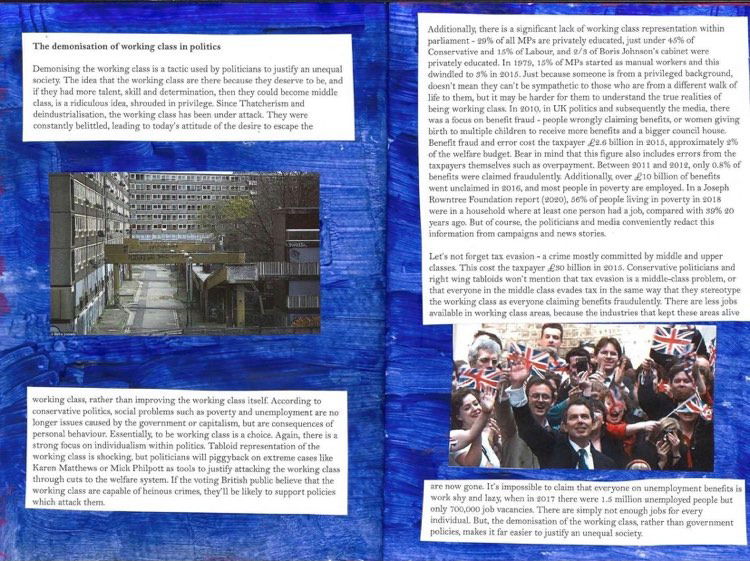
New Labour (not including Jeremy Corbyn’s Labour, in my opinion) such as Tony Blair and Gordon Brown were also guilty of this demonisation. Gordon Brown focused far more on the narrative of trying to escape the working class rather than that of its improvement. He had a very individualistic approach. This does not mean that Old Labour wasn’t entirely problematic - they were very sexist and racist - something that New Labour attempts to break away from - however, they don’t seem to care about improving the working class, they only seem to focus on escaping it, leaving room for only a select few to enter the middle class whilst leaving others behind and blaming them for not working hard enough. When politicians discuss the lack of aspiration amongst working class children and teenagers, poor results and poverty often spanning generations, they often blame this on their attitude, and not the lack of jobs and apprenticeships available to them since the collapse of the industry.
When it comes to antisocial behaviour, most of the working class wants to tackle this problem. Instead of addressing the root cause - poverty and unemployment - Tony Blair decided to demonise working class youth even further by introducing ASBOs in 1998. ASBOs are an antisocial behaviour order. They could be imposed for minor incidents and restrict certain behaviours such as loitering or swearing in public. Violation of an ASBO could lead to a five-year prison sentence. This was abolished in the UK in 2014. The Labour government promised that ASBOs would only be given to minors in extreme circumstances, but around half of ASBOs were given to minors, and in 2005, 4/10 ASBOs were given to young people with mental health problems. ASBOs further fueled the narrative that working class youth were antisocial, aggressive, drank and did drugs excessively, and would be involved in teen pregnancies.
Tony Blair was Prime Minster between 1997 and 2007. He believes that Britain is a meritocracy. This belief furthered the narrative that those in the working class are there because they deserve to be there, because they don’t work hard enough; and the wealthiest are there because they worked the hardest, ignoring the racial and classist elements of the privilege that they were born into. Tony Blair’s Labour party also favoured escaping poverty rather than its total abolishment. New Labour policies catered towards privileged voters. 40 years ago, the way the working class would enter parliament was through trade unions and local governments, but with the power of these being stripped away, there is no viable way to enter government without an excess of, and, favourably private, education.
The rise of the BNP
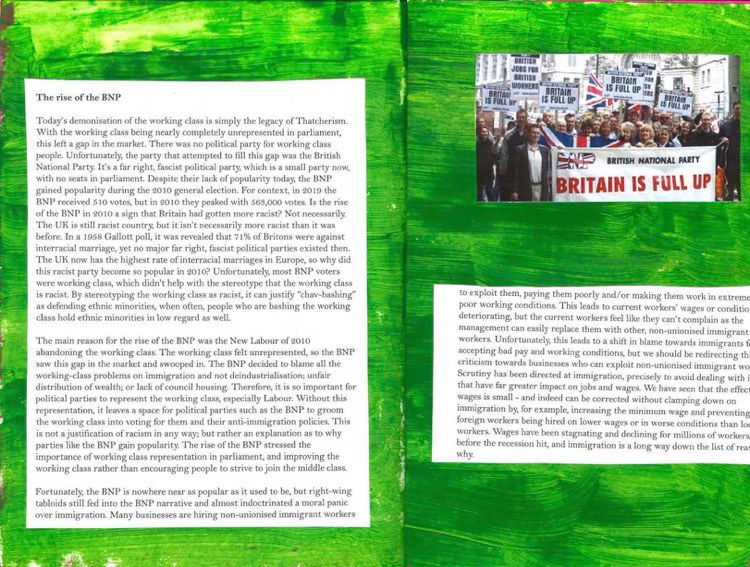
Today’s ridicule surrounding the working class is simply the legacy of Thatcherism. With the working class being nearly completely unrepresented in parliament, this left a gap in the market. There was no political party for working class people. Unfortunately, the party that attempted to fill this gap was the British National Party. It’s a far right, fascist political party, with no seats in parliament. Despite their lack of popularity today, the BNP gained traction in the 2010 general election. For context, in 2019 the BNP received 510 votes, but in 2010 they peaked with 563,000 votes. Is the rise of the BNP in 2010 a sign that Britain had gotten more racist? Not necessarily. The UK is still racist country, but it isn’t necessarily more racist than it was before. In a 1958 Gallott poll, it was revealed that 71% of Britons were against interracial marriage, yet no major far right, fascist political parties existed then. The UK now has the highest rate of interracial marriages in Europe, so why did this racist party become so popular in 2010? Unfortunately, most BNP voters were working class, which didn't help with the stereotype that the working class is racist. This stereotype is used as a mechanism to justify “chav-bashing” as defending ethnic minorities, when often; people who are bashing the working class hold ethnic minorities in low regard as well.
The main reason for the rise of the BNP was the New Labour of 2010 abandoning the working class. The working class felt unrepresented, so the BNP saw this gap in the market and swooped in. The BNP decided to blame working-class issues on immigration and not deindustrialisation; unfair distribution of wealth; or lack of council housing. Therefore, it is essential for political parties to represent the working class, especially Labour. Without this representation, it leaves a space for political parties such as the BNP to groom the working class into voting for them and their anti-immigration policies. This is not a justification of racism in any way; but rather an explanation as to why parties like the BNP gain popularity. The rise of the BNP stressed the importance of working class representation in parliament, and improving conditions rather than encouraging people to strive to join the middle class.
Fortunately, the BNP is nowhere near as popular as it used to be, but right-wing tabloids still fed into the BNP narrative and almost indoctrinated a moral panic over immigration. Many businesses are hiring non-unionised immigrant workers to exploit them; underpaying them and/or making them work in extremely poor conditions. This leads to current workers’ wages and conditions also deteriorating, but the current workers feel like they can’t complain as the management can easily replace them with other, non-unionised immigrant workers. Unfortunately, this leads to a shift in blame towards immigrants for accepting bad pay and working conditions, but we should be redirecting this criticism towards businesses that can exploit non-unionised immigrant workers. Scrutiny has been directed at immigration, precisely to avoid dealing with issues that have far greater impact on jobs and wages. We have seen that the effect on wages is small - and indeed can be corrected without clamping down on immigration by, for example, increasing the minimum wage and preventing foreign workers being hired on lower wages or in worse conditions than local workers. Wages have been stagnating and declining for millions of workers, even before the recession hit, and immigration is a long way down the list of reasons why.
Demonisation of the working class in media and news outlets
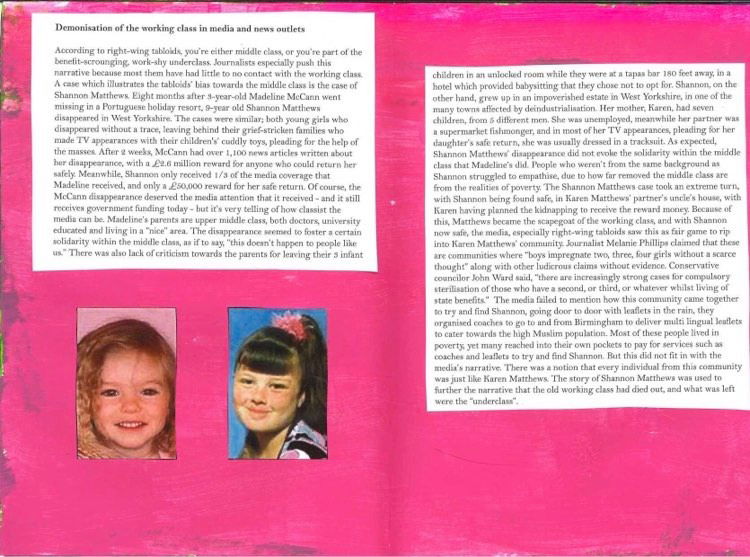
According to right-wing tabloids, you either belong to the middle class, or you’re part of the benefit-scrounging, work-shy underclass. Journalists especially push this narrative because most have had little to no contact with the working class. An illustration of tabloid bias towards the middle class is the case of Shannon Matthews. Eight months after 3-year-old Madeline McCann went missing in a Portuguese holiday resort, 9-year old Shannon Matthews disappeared in West Yorkshire. The cases were similar - both young girls who disappeared without a trace, leaving behind their grief-stricken families who made TV appearances with their children's’ cuddly toys, pleading for the help of the masses. After 2 weeks, McCann had over 1,100 news articles written about her disappearance, with a £2.6 million reward for anyone who could return her safely. Meanwhile, Shannon only received 1/3 of the media coverage that Madeline received, and only a £50,000 reward for her safe return. Of course, the McCann disappearance deserved the media attention that it received - it even receives government funding today - but it’s very telling of how classist the media can be. Madeline’s parents are upper middle class, both doctors, university educated and living in a “nice” area. The disappearance seemed to foster certain solidarity within the middle class, as if to say, “this doesn’t happen to people like us.” There was also lack of criticism towards the parents for leaving their 3 infant children in an unlocked room while they were at a tapas bar 180 feet away, in a hotel which provided babysitting that they chose not to opt for. Shannon, on the other hand, grew up in an impoverished estate in West Yorkshire, in one of the many towns affected by deindustrialisation. Her mother, Karen, had seven children, from 5 different men. She was unemployed and her partner was a supermarket fishmonger, and in most of her TV appearances, pleading for her daughter’s safe return, she was usually dressed in a tracksuit. As expected, Shannon Matthews’ disappearance did not evoke the solidarity within the middle class that Madeline’s did. People who weren’t from the same background as Shannon struggled to empathise, due to how far removed the middle class are from the realities of poverty. The Shannon Matthews case took an extreme turn, with Shannon being found safe, in Karen Matthews’ partner’s uncle’s house, with Karen having planned the kidnapping to receive the reward money. Because of this, Matthews became the scapegoat of the working class, and with Shannon now safe, the media, especially right-wing tabloids, saw this as fair game to rip into Karen Matthews’ community. Journalist Melanie Phillips claimed that these are communities where “boys impregnate two, three, four girls without a scarce thought” along with other ludicrous claims without evidence. Conservative councilor John Ward said, “there are increasingly strong cases for compulsory sterilisation of those who have a second, or third, or whatever whilst living of state benefits.” The media failed to mention how this community came together to try and find Shannon, going door to door with leaflets in the rain, they organised coaches to go to and from Birmingham to deliver multi lingual leaflets to cater towards the high Muslim population. Most of these people lived in poverty, yet many reached into their own pockets to pay for services such as coaches and leaflets to try and find Shannon. But this did not fit in with the media’s narrative. There was a notion that every individual from this community was just like Karen Matthews. The story of Shannon Matthews was used to further the narrative that the old working class had died out, and what was left were the “underclass”.
There was also the case of baby P, a London toddler who was abused by his mother and her partner severely, ultimately ending with his death. His mother and her partner were used as representatives of the working class, and the media did not focus on the council or the child protective services failing him. The media exploited the horrific death of a toddler to further dehumanise the working class. There are people in the working class who have deeply problematic lives and tendencies, but this is an extreme minority and is not representative at all. We simply only see examples of negative behaviour, as positive behaviour is not “newsworthy”.
Journalism is simply out of touch with the working class. 50% of the top 100 journalists are privately educated, despite only 7% of the British public being privately educated. Many journalists must take unpaid internships or complete paid-for training. Only people who come from families that could financially support an individual can do this. It doesn’t make sense than people like Karen Matthews are used as the ultimate symbol of the working class, but people such as Harold Shipman, a middle-class doctor who killed 250 of his patients isn’t used as a representative of the middle class, or everything that is wrong with it.
In 2009, Sir Liam Donaldson set out new regulations and recommendations that those under the age of 15 should not drink at all, and he believed that giving children a small glass of wine with their meal was a “middle class obsession”. Daily Telegraph journalist James Delling-Poll claimed that Donaldson was aiming this rule at the wrong target, and that most binge drinking took place in working class areas. However, a study by the Nation Centre of Social Research shows that those who are from affluent backgrounds are the biggest binge-drinkers, and those with unemployed parents are the mostly likely to have never tried alcohol. Once again, the demonisation of the working class in the media, and particularly right-wing tabloids, gives a justification for why people are in poverty and makes the public believe that those who are in poverty are there because of a lack of merit.
Working class representation in entertainment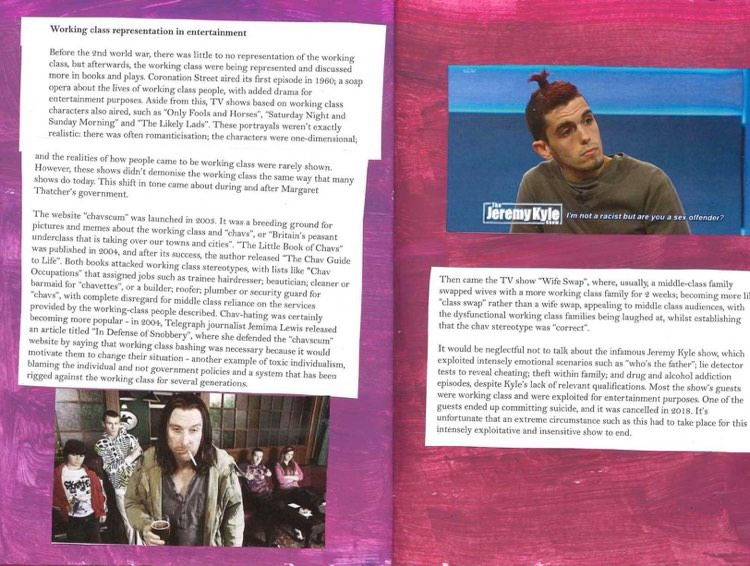 Before the 2nd world war, there was little to no representation of the working class, but afterwards, the working class was being represented and discussed more in books and plays. Coronation Street aired its first episode in 1960; a soap opera about the lives of working class people, with added drama for entertainment purposes. Aside from this, TV shows based on working class characters also aired, such as “Only Fools and Horses”, “Saturday Night and Sunday Morning” and “The Likely Lads”. These portrayals weren’t exactly realistic: there was often romanticisation; the characters were one-dimensional; and the realities of how people came to be working class were rarely shown. However, these shows didn’t demonise the working class the same way that many shows do today. This shift in tone came about during and after Margaret Thatcher’s government.
The website “chavscum” was launched in 2003. It was a breeding ground for pictures and memes about the working class and “chavs”, or “Britain’s peasant underclass that is taking over our towns and cities”. “The Little Book of Chavs” was published in 2004, and after its success, the author released “The Chav Guide to Life”. Both books attacked working class stereotypes, with lists like "Chav Occupations” that assigned jobs such as trainee hairdresser; beautician; cleaner or barmaid for “chavettes”, or a builder; roofer; plumber or security guard for “chavs”, with complete disregard for middle class reliance on the services provided by the working-class people described. Chav-hating was certainly becoming more popular - in 2004, Telegraph journalist Jemima Lewis released an article titled “In Defense of Snobbery”, where she defended the “chavscum” website by saying that working class bashing was necessary because it would motivate them to change their situation - another example of toxic individualism, blaming the individual and not government policies and a system that has been rigged against the working class for several generations.
Then came the TV show “Wife Swap”, where, usually, a middle-class family swapped wives with a more working class family for 2 weeks; becoming more like “class swap” rather than a wife swap, appealing to middle class audiences, with the dysfunctional working class families being laughed at, whilst establishing that the chav stereotype was “correct”.
It would be neglectful not to talk about the infamous Jeremy Kyle show, which exploited intensely emotional scenarios such as “who’s the father”; lie detector tests to reveal cheating; theft within family; and drug and alcohol addiction episodes, despite Kyle’s lack of relevant qualifications. Most the show’s guests were working class and were exploited for entertainment purposes. One of the guests ended up committing suicide, and it was cancelled in 2018. It’s unfortunate that an extreme circumstance such as this had to take place for this intensely exploitative and insensitive show to end.
Then, there is the case of Little Britain. Vicky Pollard is not the most problematic character, as there were racist jokes and blackface on the show, however the Vicky Pollard character as a representation of the working class is still a harmful stereotype. She had 10 children, smoked, was aggressive, had a low IQ, and wore a tracksuit. You can pass this off as harmless fun, but it may not have been completely understood that she was a caricature. A survey taken at the 2006 Edinburgh Film Festival revealed that most people working in television thought that Vicky Pollard was an accurate representation of a working-class single mother.
You may also have heard of the long-running TV hit Shameless, written by Paul Abbott, and based on his experiences growing up working class. When it was originally written, it was very autobiographical, but it turned out very downbeat and depressing; and was rewritten as a comedy. Most Shameless watchers are middle class. Because of this, and middle class lack of contact with the working class, Shameless is viewed more as a documentary rather than a largely fictional comedy. Robin Wilson interviewed working class viewers of Shameless, and he concluded that viewers “declared their discomfort in watching Shameless because they feel they are being invited to laugh at their own class”.
There are also reality shows like “Can’t Pay? We’ll take It Away” which follows bailiffs that repossess people’s items and evict people from their homes. Many people on this show are working class people in critical circumstances, and the fact that this is being exploited for reality television is deplorable. This only creates a further degree of separation for the middle class from the working class - something that these shows all have in common. Someone who has never had a conversation with someone from the working class may believe that these representations in entertainment are accurate, which is damning for real working class people, who are reduced to a mere stereotype.
More representation of accurate characters that portray the reality of the working class, and the reasons why they ended up there is needed. With the introduction of Netflix and other streaming platforms, there are more opportunities for shows and films to be produced with less political pressure to portray the working class a certain way, such as Chewing Gum and I, Daniel Blake.
The working class “aesthetic”
The working-class aesthetic has gained a lot of popularity over the last decade, with the middle and upper classes appropriating it. The “aesthetic” can range - not just with the use of fashion, hair, makeup, although that can play a huge role, but it can also be about accent, use of language, and music taste.
Of course, accent and language use can genuinely change over time, depending on where you reside and who you associate with, and you can pick up traits from others. However, there is a difference between your accent altering and a slight change of language due to outside influences over the course of a few years, and going to university, starting to listen to grime or drum and bass, and suddenly saying “my g”, “bless” and “what you saying”. I’m not trying to police listening to certain music and wearing a puffer coat, but the rapid change from having a middle class, privately educated accent, to saying “fam”, “what you saying” and “bless”, seems forced. The problematic aspect of this “trend” is that many people who appropriate working class culture, listen to grime, wear tracksuits and puffer coats, and use language like “wagwan”, will take the opportunity to insult the working class, and vote conservative, a party which specifically targets the most vulnerable people in society - i.e. the working class and ethnic minorities. Or, they'll vote for Labour for a few years, mostly because their friends do it, but as soon as they graduate and get a well-paid job through a connection their dad has, they suddenly will start voting conservative again. It’s comparable to “trying on” the working-class struggle, and then at any given moment being able to resume a middle class, privileged, tory-voting lifestyle. This may be an over simplification and generalising but there are true examples of this.
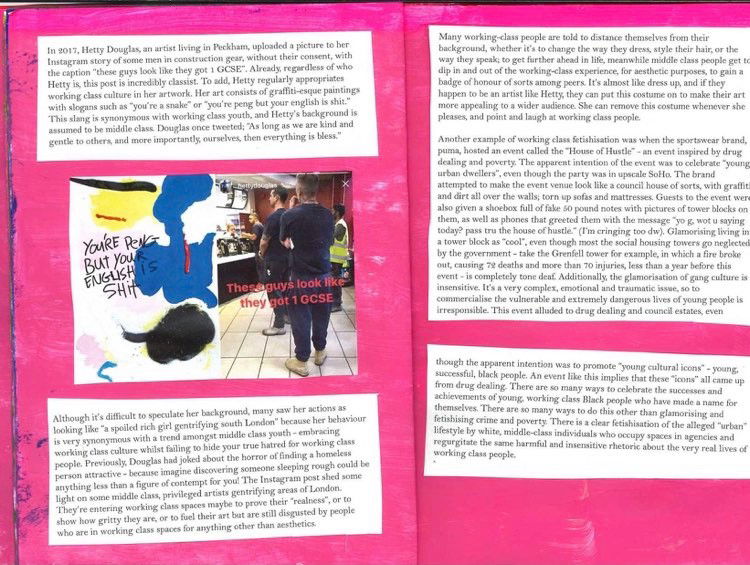
In 2017, Hetty Douglas, an artist living in Peckham, uploaded a picture to her Instagram story of some men in construction gear, without their consent, with the caption “these guys look like they got 1 GCSE”. Already, regardless of who Hetty is, this post is incredibly classist. To add, Hetty regularly appropriates working class culture in her artwork. Her art consists of graffiti-esque paintings with slogans such as “you’re a snake” or “you’re peng but your English is shit.” This slang is synonymous with working class youth, and Hetty’s background is assumed to be middle class. Douglas once tweeted; “As long as we are kind and gentle to others, and more importantly, ourselves, then everything is bless.” Although it’s difficult to speculate her background, twitter saw her actions as looking like “a spoiled rich girl gentrifying south London” because her behaviour was very synonymous with a trend amongst middle class youth - embracing working class culture whilst failing to hide your true hatred for working class people. Previously, Douglas had joked about the horror of finding a homeless person attractive - because imagine discovering someone sleeping rough could be anything less than a figure of contempt for you! The Instagram post shed some light on several middle-class, privileged artists gentrifying areas of London. They’re entering working class spaces maybe to prove their “realness”, or to show how gritty they are, or to fuel their art but are still disgusted by people who are in working class spaces for anything other than aesthetics.
Many working-class people are told to distance themselves from their background, whether it’s to change the way they dress, style their hair, or the way they speak; to get further ahead in life, meanwhile middle class people can dip in and out of the working-class experience, for aesthetic purposes, to gain a badge of honour of sorts among peers. It’s almost like dress up, and if they happen to be an artist like Hetty, they can put this costume on to make their art more appealing to a wider audience. She can remove this costume whenever she pleases, and point and laugh at working class people.
Another example of working class fetishisation was when the sportswear brand, Puma, hosted an event called the “House of Hustle” - an event inspired by drug dealing and poverty. The apparent intention of the event was to celebrate “young urban dwellers”, even though the party was in upscale SoHo. The brand attempted to make the event venue look like a council house of sorts, with graffiti and dirt on the walls; torn up sofas and mattresses. Guests to the event were also given a shoebox full of fake 50 pound notes with pictures of tower blocks on them, as well as phones that greeted them with the message “yo g, wot u saying today? pass tru the house of hustle.” (I’m cringing too dw). Glamorising living in a tower block as “cool”, even though most the social housing towers go neglected by the government - Grenfell tower for example, in which a fire broke out, causing 72 deaths and more than 70 injuries, less than a year before this event - is completely tone deaf. Additionally, the glamorisation of gang culture at an event like this is insensitive. It’s a very complex, emotional and traumatic issue, so to commercialise the vulnerable and extremely dangerous lives of young people is irresponsible. This event alluded to drug dealing and council estates, even though the apparent intention was to promote “young cultural icons” - young, successful, Black people. An event like this implies that these “icons” all came up from drug dealing and impoverished backgrounds. There are so many ways to celebrate the successes and achievements of young, working class Black people who have made a name for themselves, without glamorising and fetishising crime and poverty. There is a clear fetishisation of the alleged “urban” lifestyle by white, middle-class individuals who occupy spaces in agencies and regurgitate the same harmful and insensitive rhetoric about the very real lives of working class people.
